
Compact, Full Range of Functionality, Affordable Switcher
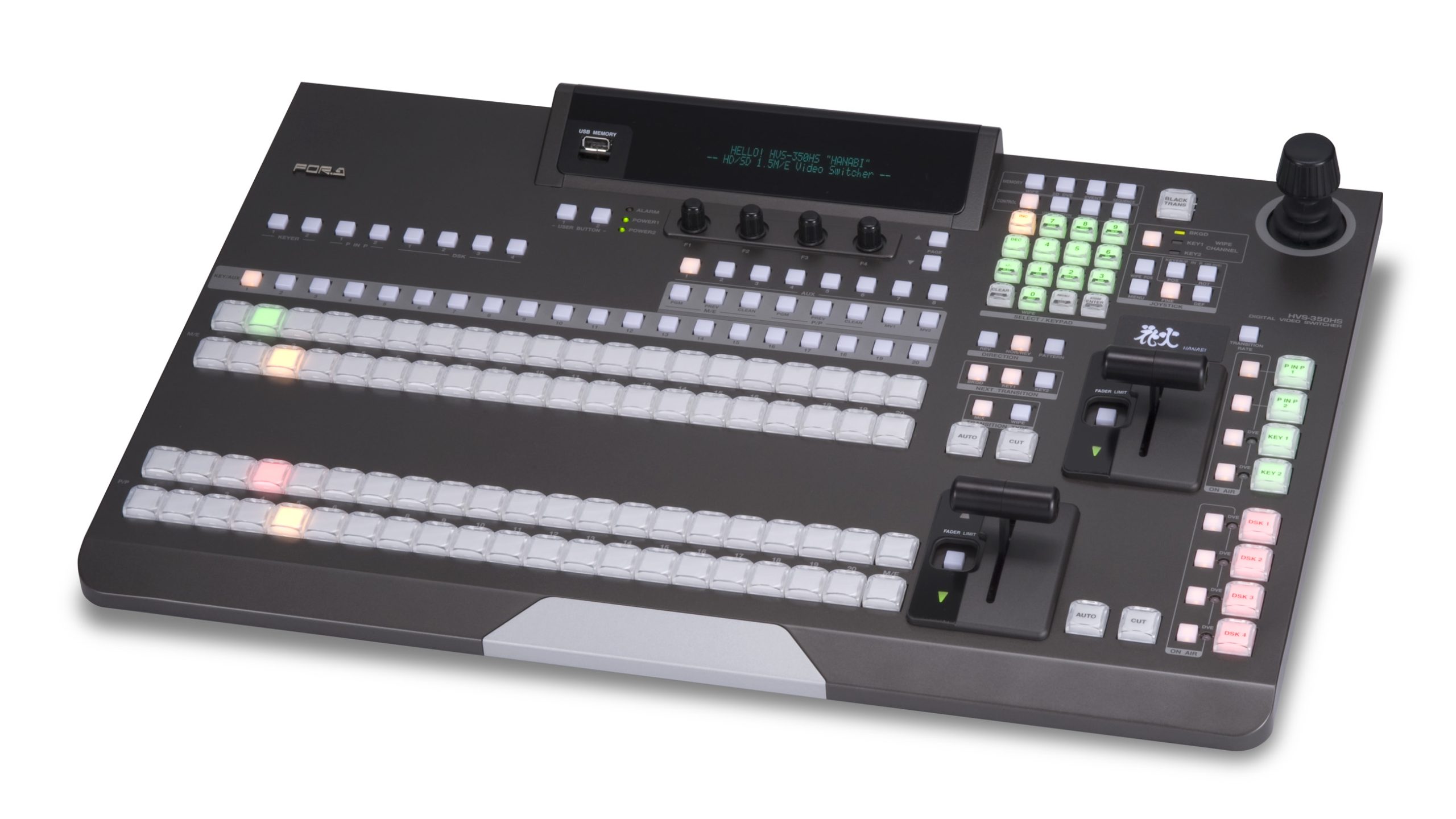
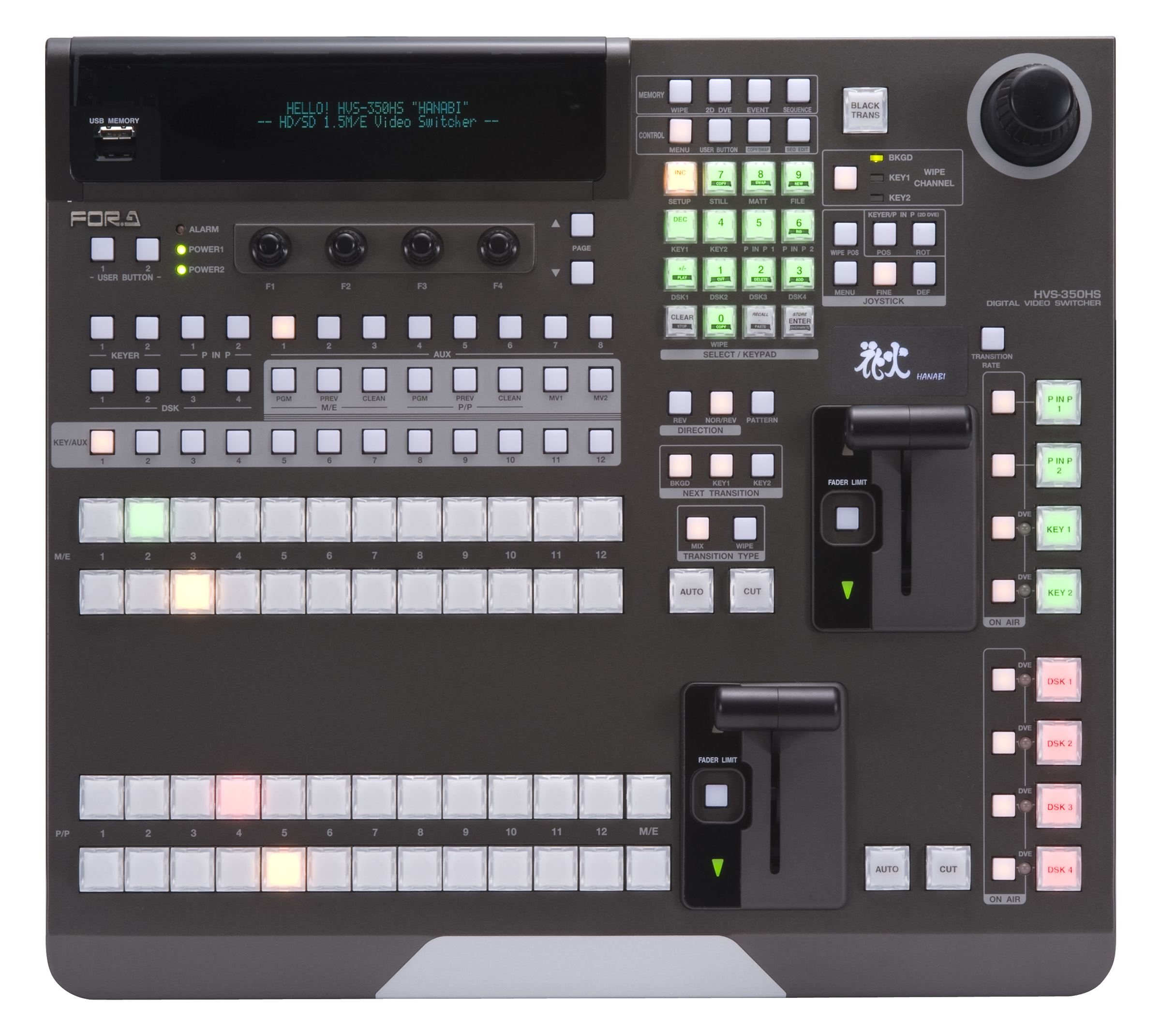
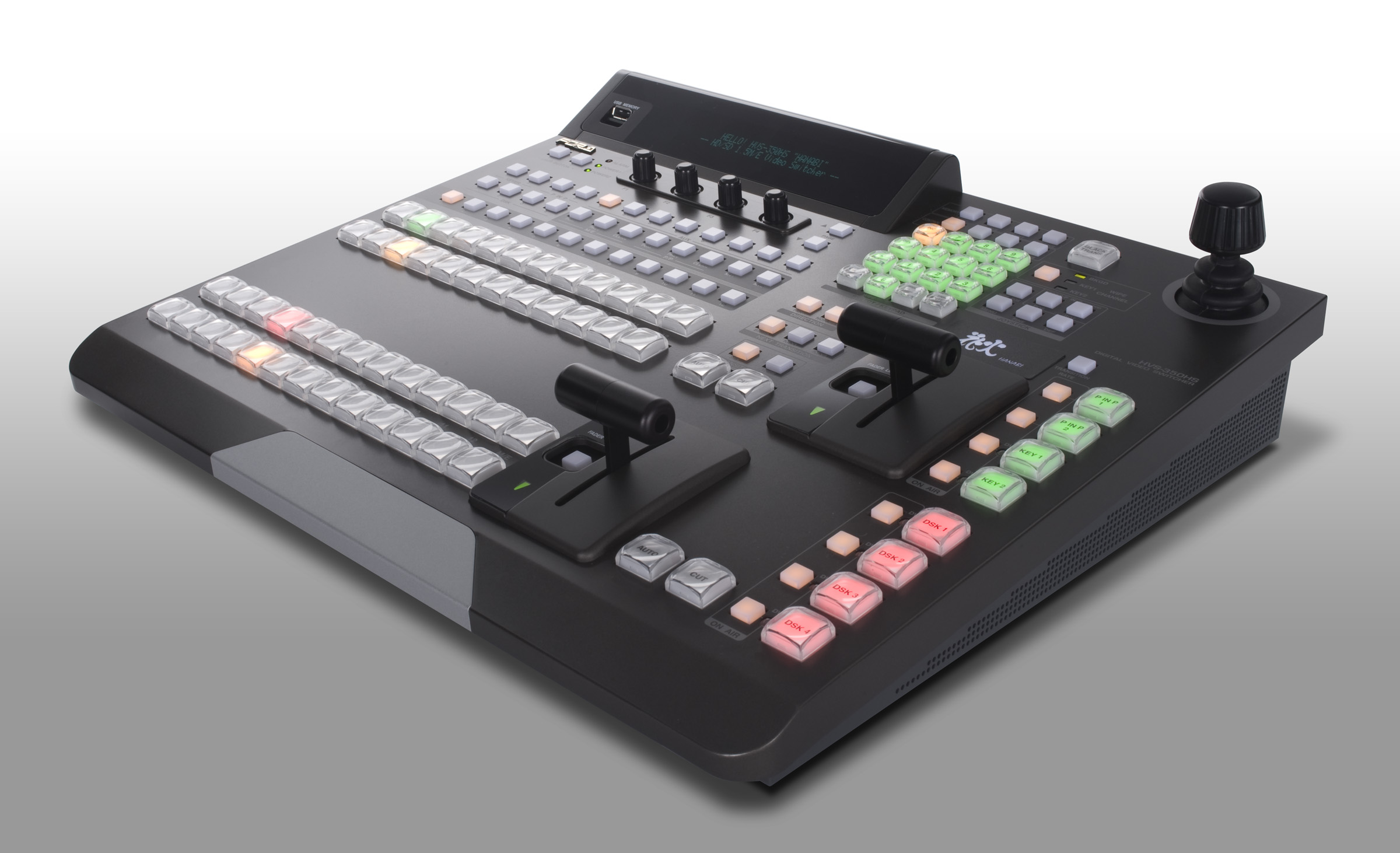
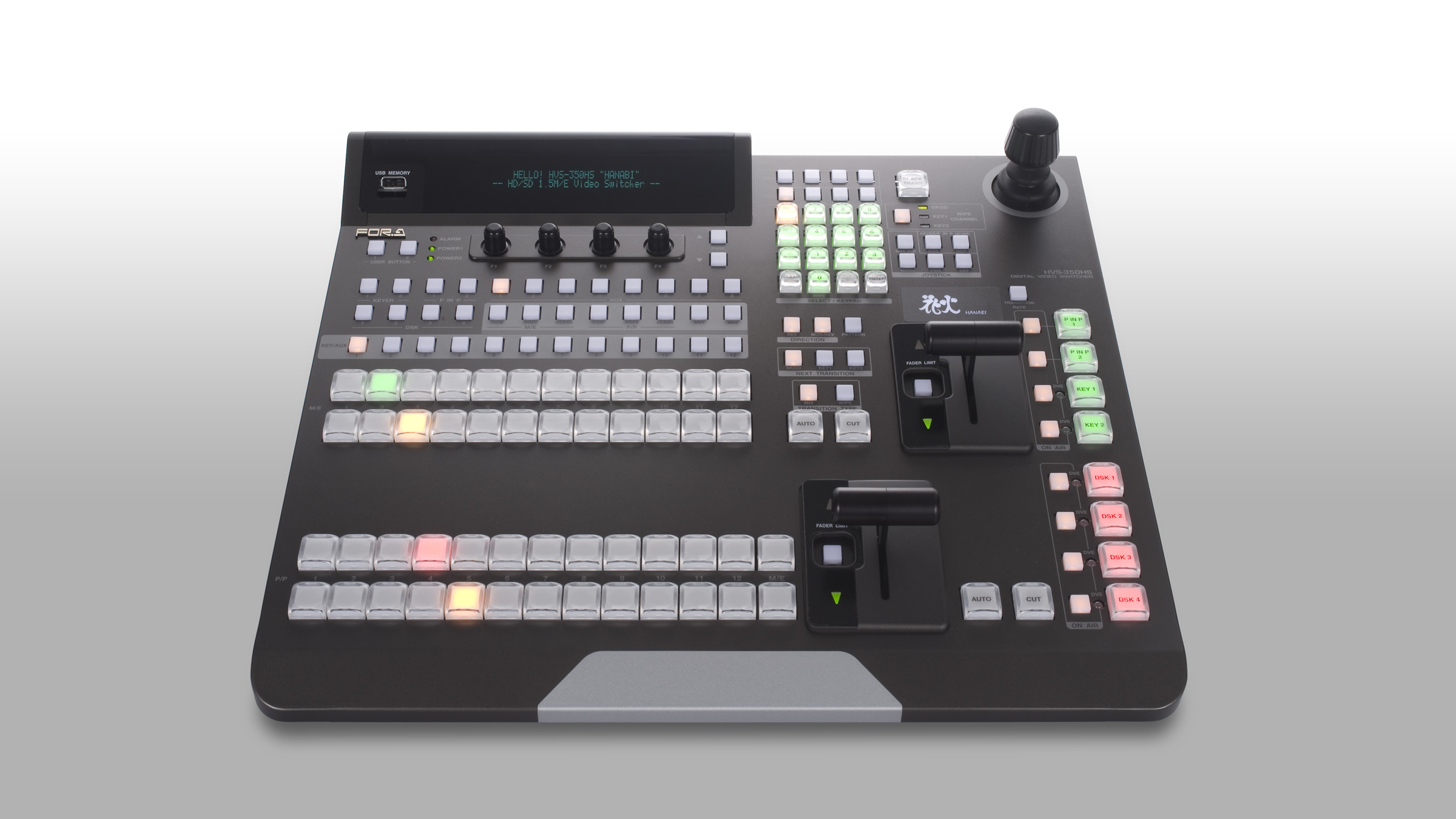
Announcing a 1.5 M/E model in the FOR-A HVS-300HS Series of portable video switchers noted for plentiful functions and excellent cost-performance. The HVS-350HS is the video switcher pushing functionality and operability to new heights. Like the HVS-300HS, it offers a full range of functionality, including mixed HD/SD input, frame synchronizer, 2D and 3D wipe effects, DVE, keyer with chroma key (2 channels), DSK (4 channels), still stores (4 channels), picture in picture (2 channels) and 16-split multiviewer (2 channels). It retains the unique specifications that allow selection of operation style and can be used on all types of locations for almost anything (live, events, news, outside broadcasting vans, sports, editing, presentations, etc.). The HVS-350HS offers new innovations to the video switcher genre.

Announcing a 1.5 M/E model in the FOR-A HVS-300HS Series of portable video switchers noted for plentiful functions and excellent cost-performance. The HVS-350HS is the video switcher pushing functionality and operability to new heights. Like the HVS-300HS, it offers a full range of functionality, including mixed HD/SD input, frame synchronizer, 2D and 3D wipe effects, DVE, keyer with chroma key (2 channels), DSK (4 channels), still stores (4 channels), picture in picture (2 channels) and 16-split multiviewer (2 channels). It retains the unique specifications that allow selection of operation style and can be used on all types of locations for almost anything (live, events, news, outside broadcasting vans, sports, editing, presentations, etc.). The HVS-350HS offers new innovations to the video switcher genre.
A frame synchronizer function comes standard for input. This enables asynchronous signals to be switched as is. Aside from HD/SD mixed input, installation of option board supports asynchronous picture input, e.g. from PC. Also comes equipped with Proc Amp function capable of adjusting video level, chroma level, etc. of input signal.
A re-size engine (expansion) is provided on 4 of the 8 standard inputs and the optional input board HVS-30HSDI. This achieves a fully mixed SD and HD environment with a switcher alone, with no need to connect an external device such as an up-converter. This is naturally suitable for re-sizing not only SD signals but also PC video.
(The HVS-30HSDI-A option does not have a re-size function)

When reading out events from current settings, you can call them up while assisting the transition to the event’s registered status. Freely set the events to be called up and the time to assist to the registered status. Doing the same thing with previous video switchers requires using a sequence function, a time-consuming job that includes selecting patterns. In contrast, the HVS-350HS can switch seamlessly to a recorded state with the same operation as the event memory, making this function very useful for live performances, etc.
Two keyer channels and 4 DSK channels come standard. The keyer also has a chroma key function. And since the keyer and DSK each have their own dedicated 2D DVE, scale effects or other 2D effects can be individually added to them.
Besides the 2D DVEs that come with the keyer and DSK, two channels of 3D DVEs come standard. The 3D DVEs can be assigned freely, allowing you to assign them to the background as well as Keyer 1 and Keyer 2. Cut, mix and wipe can be chosen for the M/E bus transition. Only cut and mix are available for the P/P bus. Wipe patterns include 100 2D wipe patterns and 68 DVE wipe patterns such as page turn. Along with wipes, effects like mosaic and defocus are also provided.
Four still store channels are provided standard. Externally created still data can be sent to the main unit via Ethernet. Reading through USB memory is also supported when connected to HVS-35OU/ 35ROU/30OU. Backup function stores data internally and allows reading of saved data after restarting power. Supported file formats are JPEG, TGA and BMP.
A multiviewer function, capable of displays of up to 16 splits, comes standard with 2 channels. Supports 4-split, 10-split and 16-split display patterns. The ability to make different display patterns and channel settings for each ensures flexible operation. Display channels can be freely assigned, allowing assignment of not only input source but also output picture such as PGM or PREV. Each channel offers title display and tally display functions. With the addition of the AUX assignment function, all the channels from input to output can now be checked on the multiviewer.

Two channels of dedicated Picture-in-Picture (P-in-P) circuits are provided, separate from the wipe effect function. The picture can be enlarged, shrunk, repositioned, cropped or given a border. Register an operation in advance to a user button, and just that one button is all it takes to fade, slide or zoom in or out or perform other operations. Making full use of P-in-P, keyer and DSK 2D DVE lets you display P-in-P screen with up to 8 pictures.

HD/SD-SDI 8 input/8 output come standard. Support for mixed input of HD and SD signal comes standard. The 8 output channels include M/E PGM (1 channel), PGM (1 channel) and AUX (6 channels). AUX can be assigned for preview or multiviewer. Inputs and outputs can be expanded to 24 and 12 respectively. Aside from HD/SD-SDI, other inputs and outputs can be installed, including analog component, analog composite, DVI and RGB.

With the DSK free assignment function on, the HVS-350HS alone is sufficient to achieve a multi-monitor environment in which multiple monitors are connected. You can easily achieve a multi-monitor setup on up to four screens by assigning four channels of DSK to four AUX channels and using the standard feature 2D DVE for the DSK in a state where the same source has been selected for each channel to enlarge the display of a portion of the video and transform and transition to match the arrangement of monitors.
Usually, a separate processor would be required for multi-monitor use, but with the HVS-350HS, a switcher alone can output for multi-monitor use separately from the main channel. This unique feature is a great help in every aspect of production including operations, equipment and systems.
Maximum of 60-frame clip video with alpha channel, which is available for CG WIPE.
Supports not only M/E and P/P bus, but also AUX bus transition switching. As a result, when displaying videos on a separate monitor besides the main system, you can actively use AUX to expand the range of your production.
Offers four channels of DSK that you can freely assign. Assign to any of M/E, P/P or AUX. Also, with DSK, M/E composite results can be used as an input source, so even a 1.5 M/E switcher can be operated as a 2 M/E switcher.
External interfaces include an Editor port for connecting to an editing machine, GPI port supporting up to 10 inputs and 20 outputs, RS-422 port for connecting an HVS-30RU, etc., ARCNET port for connecting an operation unit or AUX remote panel, and Ethernet port used during PC control.
The PREV or AUX monitor settings screen can be displayed on-screen. This lets you make various settings while viewing the picture. Of course, stable output is guaranteed with PGM, even when the menu is on display.


The HVS-350HS offers a stereo 3D option, enabling not only simultaneous switching of the two channels left and right, but also simultaneous output on the two channels left and right. Field sequential output* is also possible, making it easy to check video. While not meant for regular viewing, since switching takes place in field units, it is valuable for checking the status of stereo 3D video onsite.
*Field sequential output:
A function that outputs two output video feeds alternately in field units from one channel of output. This makes it possible to preview the status of S3D video using only an interlaced monitor and shutter glasses.
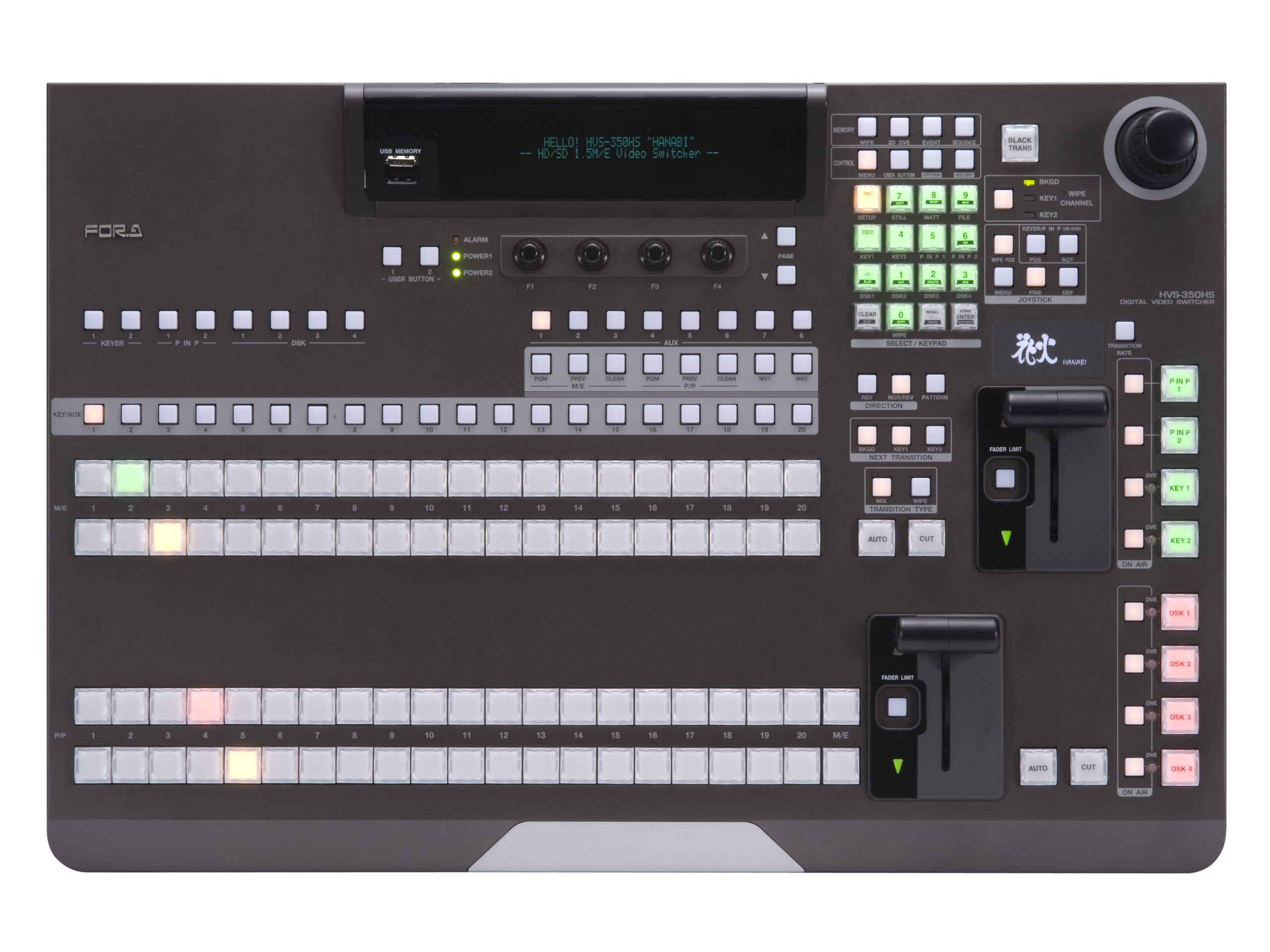
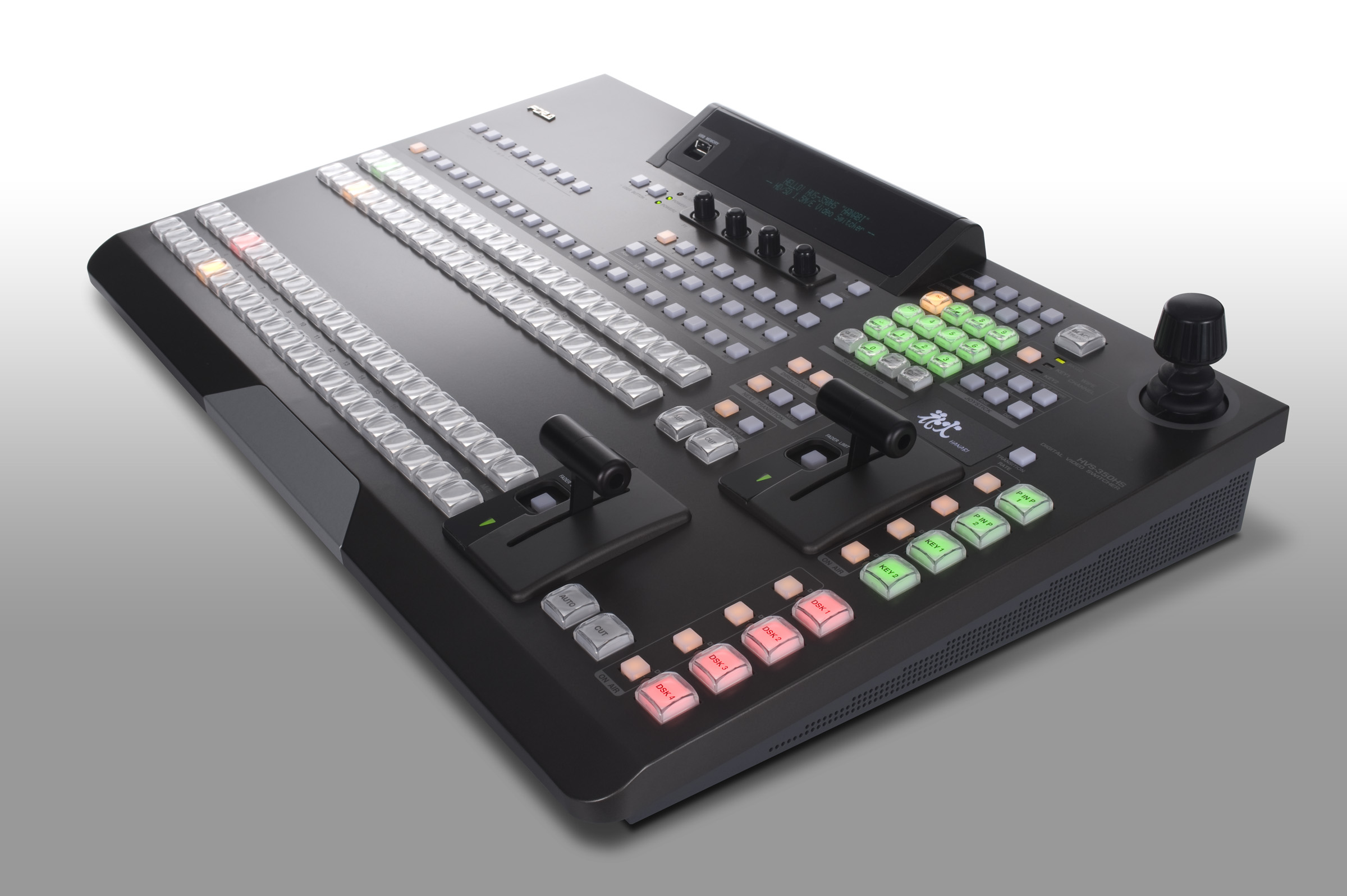
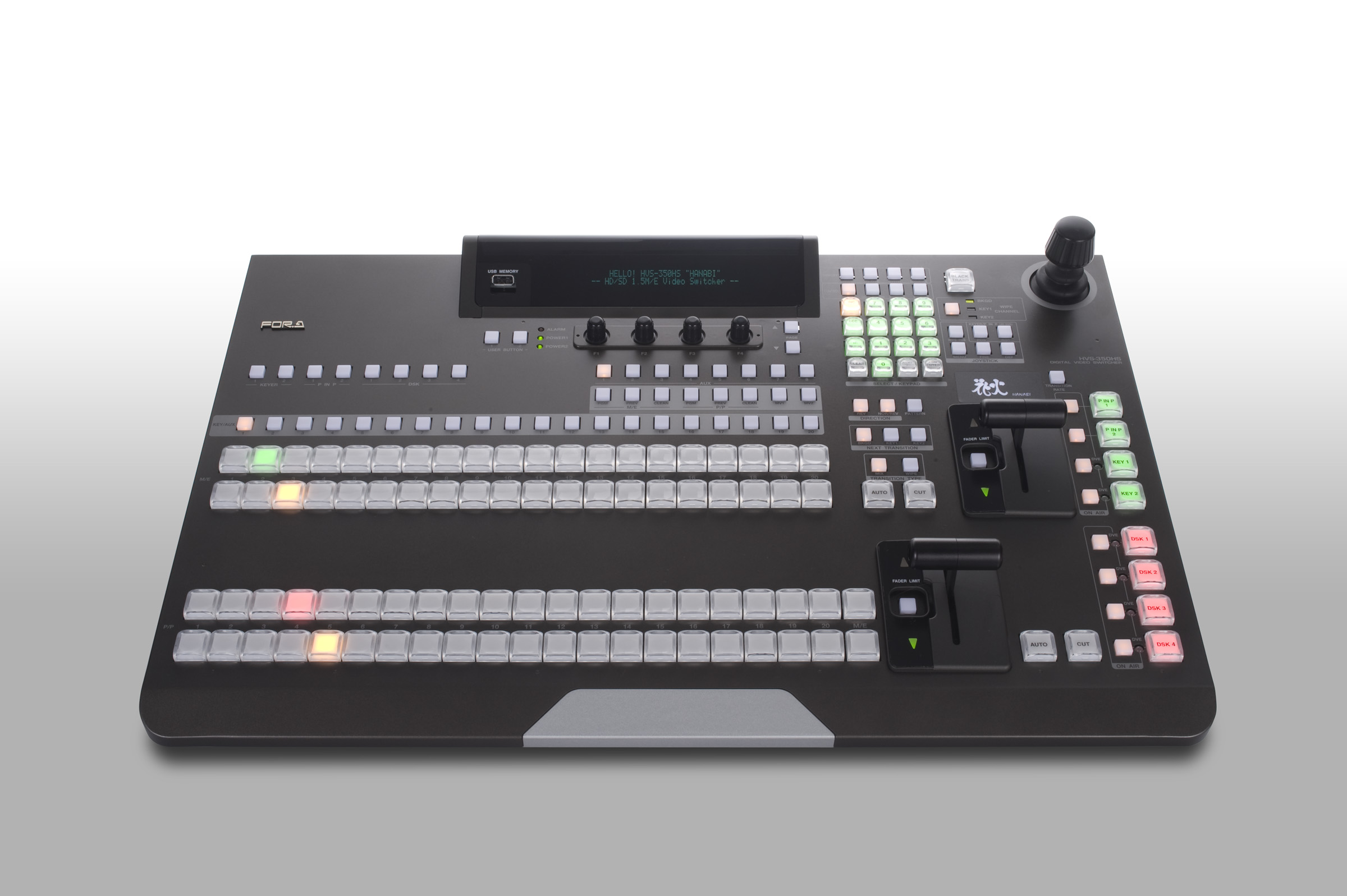
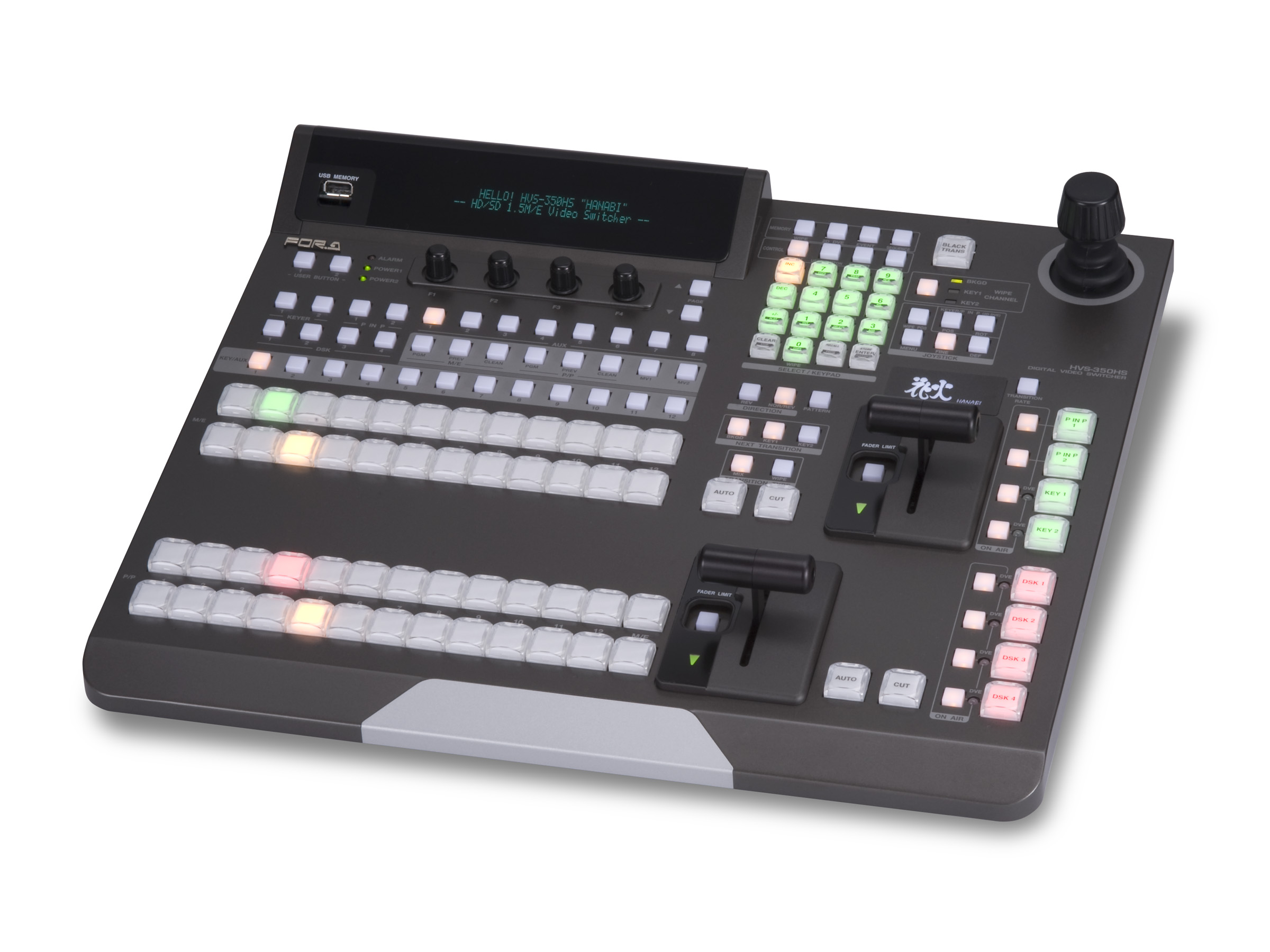
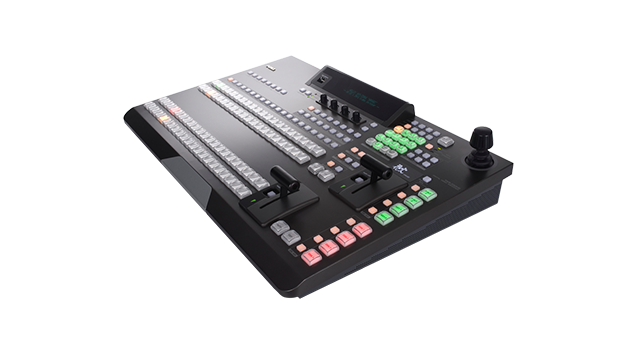
This Control Panel is optimized for HVS-350HS functions. Provides 20 bus buttons, dedicated fade levers for M/E and P/P buses respectively, 3-axis joystick, and direct buttons for various functions, all in an easy to use arrangement.
The operation interface has a USB interface. It can also be used for saving or reading still store content, backing up various parameters, etc. ARCNET is used for connecting to the main unit, which enables extending the connection up to 100 meters with a single BNC cable.

A Control Panel designed to rack-mounting size while retaining the operability of the HVS-35OU. It has 12 bus buttons. Other buttons and functions are as in the HVS-35OU.

This is the control panel for the 1M/E video switcher HVS-300HS, but it allows operation of the M/E bus or P/P bus of the HVS-350HS. Like the HVS-35ROU, it is rack-mountable. Though there are limits on functions accessible from the buttons, the use of GPI and OSD functions together enables various operations with the HVS-350HS.

As with the HVS-30OU, this is a 1U size compact panel developed for the HVS-300HS, but it comes with authentic bus buttons on the operating interface, a compact liquid crystal display enabling selection of wipe patterns, and major buttons such as a rotary encoder. The use of GPI and OSD functions together enables various operations on the HVS-350HS. It can also function as the AUX remote panel of the HVS-350HS main unit.

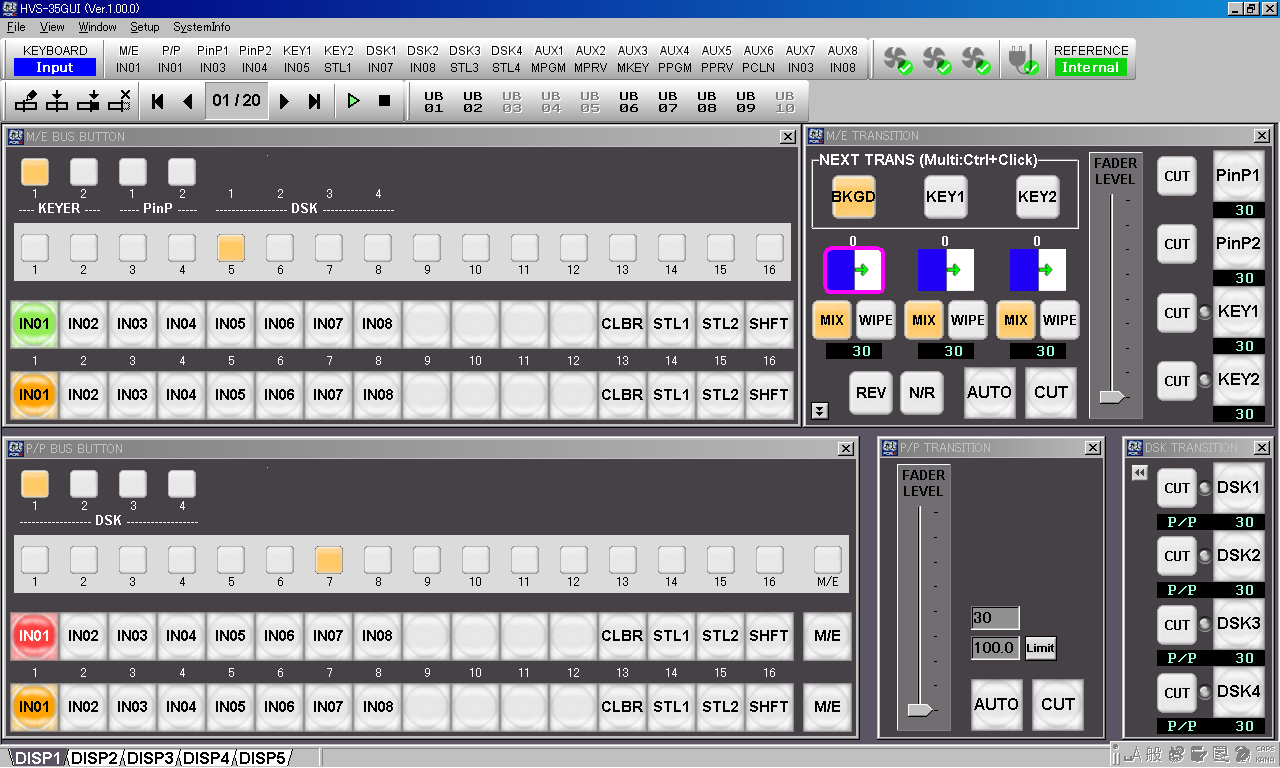
Control software that is used by installing to a PC. The intuitive function window enables full control of the HVS-350HS. Also provided are power source and fan status displays, a function to switch among display layouts for 5 patterns, keyboard shortcuts and many other functions that software makes possible. (A separate PC is required to use.)

With the HVS-350HS, you can add just the input and output formats you need, in just the amount needed. There are 4 expansion slots for input and 2 for output. Aside from HD/SD-SDI, other inputs and outputs can be installed, including analog component, analog composite, DVI and RGB.
4 channels of HD/SD-SDI input card. 2 types of card available; HVS-30HSDI has a frame synchronizer function and re-size (expansion) function provided for all inputs, and SD images can be processed internally as HD images.
HVS-30HSDI-A has a frame synchronizer function (no resize) provided for all inputs. It is an expansion card with excellent cost-performance.

2 channels of HD/SD-SDI output card. Dedicated down-convert output also provided for 2 output terminals. This realizes simultaneous output of HD and SD.

2 channels of analog video input signal. Input terminal 2 is a dedicated connector (conversion connector supplied). The user can select between analog composite or analog component (HD or SD) input for each input terminal.

2 channels of analog video output card. Output terminal 2 is a dedicated connector (conversion connector supplied). The user can select between analog composite or analog component (HD or SD) output for each output terminal.

For computer-based applications we have an input card with one DVI-D and one VGA connector with resolutions ranging from VGA to WUXGA.

| HD mode | 1080i/PsF | 1024 x 768 (XGA), 1280 x 1024 (SXGA), 1600 x 1200 (UXGA), 1280 x 768 (WXGA), 1680 x 1050 (WSXGA), 1920 x 1200 (WUXGA) |
|---|---|---|
| 720p | 1024 x 768 (XGA), 1280 x 1024 (SXGA), 1280 x 768 (WXGA) | |
| SD mode | 640 x 480 (VGA), 800 x 600 (SVGA), 1024 x 768 (XGA) | |
HDCP incompatible; DVI-D and VGA output not supported in 1080PsF format.
For computer-based applications we have an output card with one DVI-D and one VGA connector with resolutions ranging from VGA to WUXGA.

| HD mode | 1080i/PsF | 1280 x 1024 (SXGA), 1600 x 1200 (UXGA), 1680 x 1050 (WSXGA), 1920 x 1080 (HDTV), 1920 x 1200 (WUXGA) |
|---|---|---|
| 720p | 1280 x 1024 (SXGA), 1280 x 768 (WXGA) | |
| SD mode | 800 x 600 (SVGA) | |
HDCP incompatible; DVI-D and VGA output not supported in 1080PsF format.
An 8-button or 16/32-button type AUX remote control panel is provided. The 8-button unit is half-rack size and 16/32-button unit is 1U rack size; ARCNET allows cascading connection of as many as 5 units. With the panel extension kit, each panel can be used with a longer button interface.

A stereoscopic 3D option enables not only simultaneous switching of the two channels left and right, but also simultaneous output on the two channels left and right. Field sequential output is also possible, making it easy to check video. While not meant for regular viewing, since switching takes place in field units, it is valuable for checking the status of stereoscopic 3D video onsite.
Open collector-type HVS-TALOC20/32 or relay-type HVS-TALR20/32 can be connected. They are both half-rack size, and as many as 4 units can be connected to 1 HVS-350HS.

Tally relay interface card (18 terminals). Up to 2 cards can be installed (the slot is shared with I/O cards).
This is a software for supporting editing machine protocol. It supports BVS/DVS and GVG protocol.
| Number of M/Es | 1.5 M/E |
|---|---|
| Control Panel | 5 types HVS-35OU: 1.5 M/E 20-button model HVS-35ROU: 1.5 M/E 12-button model HVS-30OU: 1 M/E 12-button model HVS-30RU: 1 M/E 12-button model (OSD menu display) HVS-35GUI: GUI application (PC required) |
| Video Formats | 1080/59.94i, 1080/60i, 1080/50i, 1080/24PsF, 1080/23.98PsF, 1080/25PsF, 1080/29.97PsF, 1080/30PsF, 720/59.94p, 720/60p, 720/50p, 525/60 (NTSC) , 625/50 (PAL) |
| Video Input | HD-SDI: 1.5 Gbps or SD-SDI: 270 Mbps 75Ω BNC x 8 * Frame synchronizer on each input |
| Video Input (optional) | Selectable as below. Refer to combination chart |
| HVS-30HSDI/30HSDI HD-SDI: 1.5 Gbps or SD-SDI: 270 Mbps 75Ω BNC x 4 |
|
| HVS-30HSAI HD analog component, SD analog component, Analog composite |
|
| HVS-30PCIN DVI-D: XGA to WUXGA (1080i) (HDCP incompatible), XGA to WXGA (720p) (HDCP incompatible), VGA to XGA (SD) (HDCP incompatible) RGB: XGA to WUXGA (1080i), XGA to WXGA (720p), VGA to XGA (SD) |
|
| Number of Inputs | Standard: 8 (SDI), Max.: 24 (with HSDI x 4 or HSDI-A x 4) |
| Video Output | HD-SDI: 1.5 Gbps or SD-SDI: 270 Mbps 75Ω BNC x 8 (PGM, M/E PGM and AUX 1 to AUX 6) |
| Video Output (optional) | |
| Selectable as below. Refer to combination chart | |
| HVS-30HSDO HD-SDI: 1.5 Gbps or SD-SDI: 270 Mbps 75Ω BNC x 2 |
|
| HVS-30HSAO HD analog component, SD analog component, Analog composite |
|
|
HVS-30PCO DVI-D: SXGA to WUXGA/HDTV (1080i) (HDCP incompatible), SXGA/WXGA (720p) (HDCP incompatible), SVGA (SD) (HDCP incompatible) RGB: SXGA to WUXGA (1080i), SXGA/WXGA (720p), SVGA (SD) YPBPR: HDTV(1080i) |
|
| Number of Outputs | Standard: 8 (SDI), Max.: 12 (with 2 output cards) |
| AUX Outputs | Standard: 6, Max.: 8 * Crossfade switching available on each AUX output * OSD menu is available on a PREV output screen |
| Signal Processing | 4:2:2 Digital component |
| Quantization | HD/SD-SDI: 10-bit |
| Effect | WIPE: 100 patterns, Border and Softness, DVE: 56 patterns or more (2D, 3D and 2-channel) |
| Transition | Execution: Fader lever, AUTO or CUT button, Type: MIX or WIPE (DVE included) |
| Still Store | 4 channels (with backup feature) |
| Keyer/DSK | 6 channels (KEYER x 2 + DSK x 4) of Bus, Luminance or Full key, 2D DVE on each channel KEYER: Chroma key and Edge/Shadow effect |
| P in P | 2 channels (up to full screen size) with Mix, Slide or Scaling effect |
| Multiviewer | 2 channels with 4-, 10- or 16-way split views with title and tally display, 1 frame delay relative to PGM output |
| Process Amp | Process Amp feature on each input |
| Event Memory | 100 events, crossfade transition available when loading events |
| Sequence Memory | 10 sequences (up to 80 steps for each) |
| Genlock Input | BB: NTSC: 0.429 Vp-p/PAL: 0.45 Vp-p or Tri-level Sync: 0.6 Vp-p, 75Ω BNC x 1, loop-through (Terminate with 75Ω terminator, if unused.) |
| System Phase Adjust | Horizontal: -1/2 H to +1/2 H |
| Genlock Output | BB: NTSC: 0.429 Vp-p/PAL: 0.45 Vp-p or Tri-level Sync: 0.6 Vp-p, 75Ω BNC x 1 |
| I/O Delay |
1 H (minimum delay) 1 to 2 frames + 1 H (when FS or Up-resize engine used) 2 to 3 frames + 1 H: (when FS or Up-resize engine plus DVE used) 3 to 4 frames + 1 H: (when FS or Up-resize engine plus Output resize engine and DVE used) |
| Interfaces | Ethernet: 100BASE-TX/1000BASE-T RJ-45 x 1 * For HVS-35GUI connection |
| GPI IN: 15-pin D-sub (female) x 1 (inch screw) 10 inputs, TTL negative logic pulse or Make-contact |
|
| GPI/TALLY OUT: 25-pin D-sub (female) x 1 (inch screw) 20 outputs |
|
| GPI IN/TALLY OUT (HVS-35OU/ROU): 15-pin D-sub (female) x 1 (inch screw) 6-input/6-output, TTL negative logic pulse or Make-contact |
|
| TALLY OUT (with HVS-30TALR): 37-pin D-sub (female) x 1 (inch screw), Make-contact (18 outputs added per card, up to 2 cards available) |
|
| RS-422: 9-pin D-sub (female) x 4 (inch screw) * For HVS-30RU, VTR, router and audio mixer connection |
|
| EDITOR: 9-pin D-sub (female) x 1 (inch screw), BVS-3000 or GVG protocol |
|
| ARCNET: 75Ω BNC x 1, loop-through (Terminate with 75Ω terminator, if unused.) * For control panel and AUX remote panel connection |
|
| Temperature / Humidity | 0ºC to 40ºC / 30% to 90% (no condensation) |
| Power | 100 V AC to 240 V AC ±10%, 50/60 Hz |
| Consumption | HVS-350HS: 520 W (at 100 to 120 V AC), 528 W (at 220 to 240 V AC) |
| HVS-35OU: 26 W (at 100 to 120 V AC), 29 W (at 220 to 240 V AC) | |
| HVS-35ROU: 26 W (at 100 to 120 V AC), 29 W (at 220 to 240 V AC) | |
| Dimensions / Weight | HVS-350HS: 430 (W) x 492 (D) x 132 (H) mm / 17 kg (in Standard), 20 kg (in Full Option) |
| HVS-35OU: 576 (W) x 382 (D) x 127 (H) mm / 8.5 kg | |
| HVS-35ROU: 430 (W) x 382 (D) x 127 (H) mm / 7.5 kg | |
| Consumables | Power supply unit: Replace every 5 years Cooling fan: Replace every 6 years |
| Accessories | Manual, AC cord, Rack mount brackets and BNC cable (10 m) |
| Options | HVS-30HSDI: SDI Input card w/ up-resize engine HVS-30HSDI-A: SDI Input card w/o up-resize engine HVS-30HSAI: Analog Input card HVS-30PCIN: PC Input card HVS-30HSDO: SDI Output card HVS-30HSAO: Analog Output card HVS-30PCO: PC Output card HVS-30TALR: Tally Relay Output card (18-output) HVS-35ED: Editor Interface software HVS-35VR: Virtual Link software HVS-35S3D: 3D Monitoring software HVS-35PSM: Redundant Power Supply Unit for Main Unit HVS-35PSO: Redundant Power Supply Unit for Operation Unit HVS-AUX8/16/32: AUX Remote Control Unit HVS-TALR20/32: Tally Relay Output unit (20/32-output) HVS-TALOC20/32: Tally Open Collector Output unit (20/32-output) |
| OS | Microsoft® Windows® XP SP3 or higher Microsoft® Windows® 7 Home Premium or higher Microsoft® Windows® Vista Home Premium or higher |
|---|---|
| CPU | Intel® Pentium 4 Processor 1.2 GHz or higher |
| Memory | 512 MB or more recommended |
| HDD | 20MB or more free space |
| Interfaces | Ethernet: 100BASE-TX/1000BASE-T, at least x 1 |
| Graphics | 1280 x 768 pixels or better, 24-bit full color, Graphics card with 64 MB or more memory (OpenGL 1.0 or 2.0 supported) |